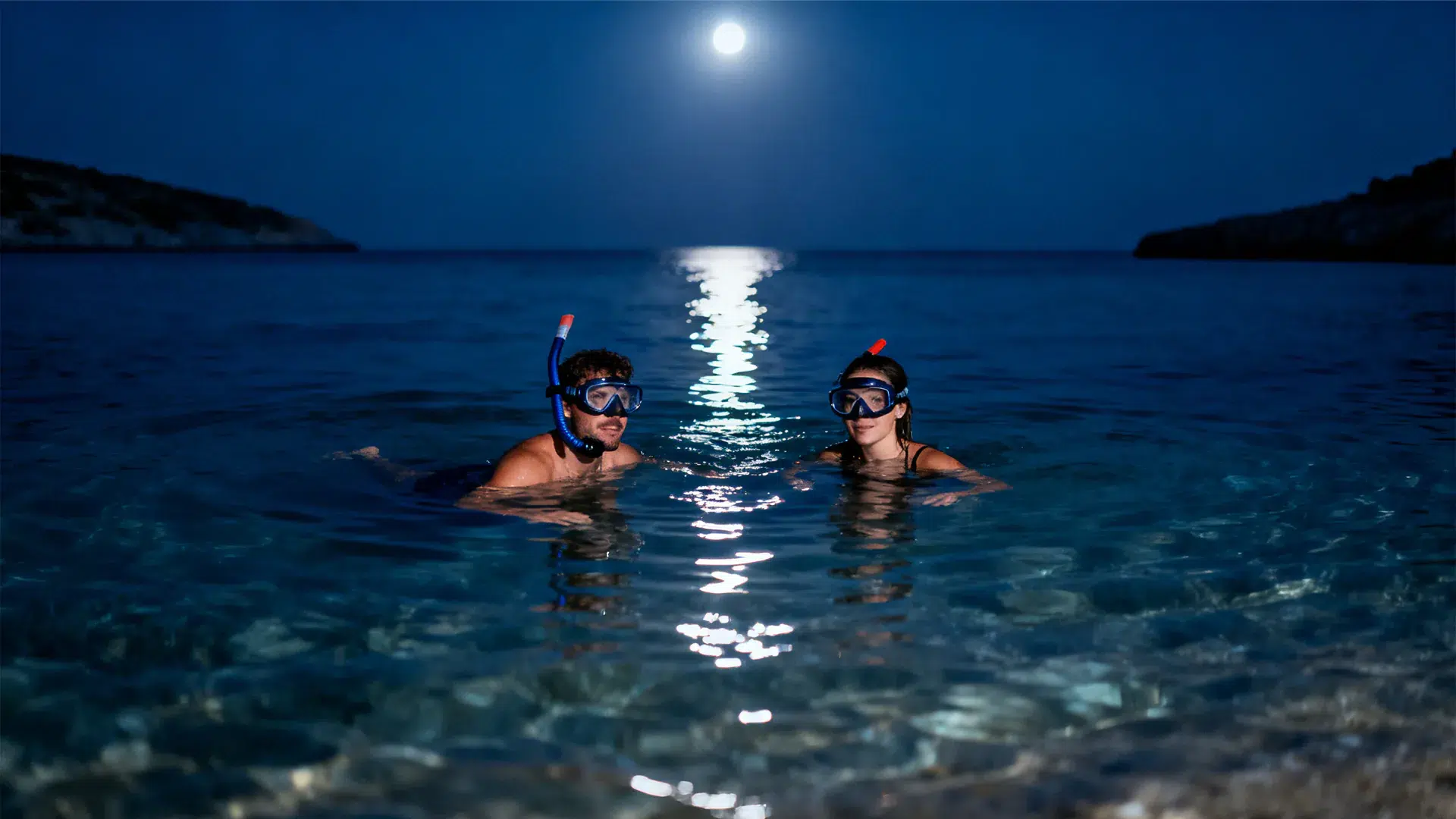
Practice Night snorkeling in Ibiza The relationship with the sea changes completely. The coastline, which during the day seems open, clear, and easy to read, becomes more precise, quieter, and also more demanding when the light fades. Orientation changes, the distance to the shore is perceived differently, and even the simplest gestures, like adjusting your mask or pausing to look at the bottom, take on a new significance.
On an island where many coves invite you to enter the water almost without thinking, to do night snorkeling in Ibiza It calls for just the opposite: less impulsiveness and more awareness of the surroundings. Choosing the right area, understanding how the water behaves at dusk, bringing the night snorkeling gear Being appropriate and moving calmly makes a real difference between a serene experience and a poorly planned entrance.
Therefore, speaking of Safe night snorkeling This doesn't diminish the beauty of the experience, but rather gives it meaning. When the place is familiar, the entrance is well thought out, and the sea is observed attentively, the night reveals a different way of swimming, of looking at the seabed, and of understanding the coast from a much more nuanced perspective.
The night changes the sea even if the cove remains the same
One of the most common mistakes is thinking that a well-known cove functions the same way during the day as at night. It doesn't. Darkness reduces reference points, narrows the field of vision, and forces you to interpret your surroundings with fewer cues. The water may appear calm from the shore, but once you're out in it, the sense of distance or direction becomes much less clear.
Body awareness also changes. Breathing often quickens at first, not always out of fear, but as a form of adaptation. This change alters buoyancy, rhythm, and movement. What comes naturally during the day requires a few minutes of adjustment at night. This initial window often determines whether the experience becomes fluid or uncomfortable.
In Ibiza, something else very distinctive occurs: many coves combine sand, rock, small underwater steps, and areas of natural shade that become more difficult to discern at night. An entrance that seemed obvious in daylight may not be so when the flashlight only reaches part of the seabed. Therefore, nighttime safety depends less on enthusiasm than on the ability to simplify the situation.
It doesn't need to be a spectacular cove, but a legible one.
When we talk about night snorkeling, we often picture rocky walls, stark contrasts, and striking underwater landscapes. However, to truly enjoy the nighttime experience, it's best to think differently. The best cove isn't necessarily the most photogenic, but rather the one that's easy to find. A gradual entry, an easy exit, a recognizable shoreline, and a short dive often offer much more than a stunning but uneven area.
quiet coves of Ibiza They have a clear advantage in this context: they allow you to focus on the water itself, rather than on solving access problems. A cove sheltered from the wind, without uncomfortable waves at the shore, and with a relatively uniform bottom in the first few meters facilitates visual and physical adaptation. This doesn't make the experience any less interesting; on the contrary, it allows for a better perception of what's happening beneath the surface.
It's also best to avoid very open areas, stretches exposed to boat traffic, or points where the coastline becomes too abrupt. At night, a complex geography can be beautiful, but it's not always practical. The easier the return to shore, the better the group will move and the more relaxed the observation will be.
What to look at before entering the water
The decisive moment doesn't begin in the sea, but a few minutes before. Assessing the cove from land is an essential part of the plan. You have to observe the surface, the type of shoreline, the entrance, the possible exit, and the actual protection from the wind. Even a light breeze can significantly change how comfortable you are once you're in the water.
It's also important to note whether the bottom starts with sand, if there's loose rock, if there are slippery slabs, or if the initial section drops off too steeply. The goal isn't to analyze every inch, but to avoid unnecessary surprises. In night snorkeling, almost all problems begin with small details that are misinterpreted.
Another important point is to visualize the return before entering the water. Knowing the angle from which you'll see the shore, what landmarks will be behind you, and how to identify the exit point provides a real sense of peace of mind. The night requires planning ahead. The less you have to improvise, the smoother the experience will be.
The team changes more than it seems
You don't need an excessive amount of equipment, but you do need certain well-chosen pieces. At night, the equipment has two very clear functions: to allow you to see your immediate surroundings and to make the group's position visible. Everything else is secondary.
The mask and snorkel should be comfortable and familiar. It's not advisable to use new equipment at night. Easy-to-handle fins, without excessive rigidity, generally work best for short trips close to the coast. As for thermal protection, a light t-shirt or a thin layer helps not only in terms of temperature but also for the overall feeling of comfort. A comfortable body breathes better and makes better decisions.
The flashlight deserves special attention. It doesn't need to be aggressive or excessively bright; what matters more is that it's reliable, has a clean beam, and allows you to clearly see the immediate background without turning your surroundings into a tunnel. Carrying a second, small light, even if only as a backup, is a sensible measure. Among all the night snorkeling gearFew things bring as much calm as knowing that the main lighting is not the only option.
In addition, a discreet buoy with a light signal is advisable. At night, being seen is just as important as seeing. The buoy organizes movement, provides a surface reference point, and greatly improves the group's location from above the water.
The partner doesn't accompany: he sustains the experience.
Going into the sea alone at night doesn't make much sense. Even a minor incident takes longer to detect and resolve when there's no one around. A mask that moves, a pulled calf muscle, misorientation, or a moment of discomfort are handled very differently if there's a human presence nearby.
That doesn't mean swimming glued together or making the experience rigid. It means maintaining a clear agreement. Moving forward at close range, exchanging glances, pausing occasionally, and confirming direction. On the night sea, coordination is more like a hushed conversation than a linear march.
When the group is small, order matters. If everyone focuses on their own activity, attention is fragmented. If everyone maintains a common point of reference, the experience becomes calmer. This simple, informal planning is often the difference between a beautiful outing and a scattered experience.
Simple signs worth agreeing to
There's no need to overcomplicate things. Simply set up a few clear signs before entering: one to stop, one to turn back, one to regroup, and one to indicate discomfort. This clarity beforehand prevents having to improvise when light, water, and distance reduce the ability to explain.
It's also a good idea to decide on a maximum distance from the starting point and an estimated time for the trip. At night, it's very easy to go a few meters further without noticing, and that small extra distance usually becomes apparent on the way back.
Getting in and out smoothly is worth more than traveling far.
Entering the water is often seen as a formality, but at night it takes on a crucial importance. It's worth taking a few seconds to enter slowly, feel the temperature, adjust your breathing, and confirm that your mask, flashlight, and flotation device are working properly. The first few meters shouldn't be used for exploring, but rather for getting used to the water.
The exit is even more important. Often, you return with a slightly lower body temperature, your vision more accustomed to the dark, and a different perception of the shore. If the return point wasn't clear from the start, the return can be awkward. That's why it's so helpful to leave a low, discreet light on the shore, sufficient to identify the exit point without disturbing the surroundings.
It's also a good idea to keep the first part of the route very close to the shore. This allows you to check if the cove holds up as expected, if the light is working well, and if the group is moving comfortably. A well-planned night doesn't need space; it needs precision.
What is discovered underwater doesn't ask for haste.
The night sea doesn't necessarily offer more, but it does offer it in a different way. Contrasts intensify, the seabed is perceived in fragments, and attention becomes more meticulous. A small crevice can resemble an entire landscape. A rock covered in discreet life takes on relief. An area of sand that goes unnoticed during the day can reveal an unexpected texture under the sidelight.
This change of scale carries a subtle risk: getting too close, staring too intently, or losing sight of the group's position by focusing on a single point. It's worth remembering that nighttime observation works best when you're not chasing after something. The beauty of the sea appears clearer when you respect distance and maintain a serene float.
In Ibiza and Formentera, the presence of Posidonia It's part of the usual underwater landscape. At night, its shadows can alter the perception of depth and make the seabed appear more irregular than it is. Observing it without touching it, without leaning on it, and without invading its space is not only an environmental matter; it also improves the reading of the underwater topography and avoids unnecessary movements.
The most frequent mistakes are usually small.
A bad night's experience rarely stems from a single major decision. It usually results from a cumulative effect: a cove chosen in haste, only one headlamp, a late entry, underestimating fatigue, or a longer-than-planned return. None of these seem serious on their own, but the sum of them all adds up.
Another common mistake is interpreting the calmness of the surface as a guarantee of safety. Sometimes the water appears motionless, yet there is a gentle drift that is barely perceptible on the way out but noticeable on the way back. There is also a tendency to overestimate the confidence gained from knowing a cove during the day. Daytime visual memory is not always reliable when the sea is reduced to a circle of light and shadow.
It's also not a good idea to turn the experience into a mini-expedition. Night snorkeling is much more enjoyable when it respects its own pace. Staying short, observing carefully, and leaving with plenty of energy usually leaves a much cleaner impression than pushing yourself a few extra meters.
When is it best not to enter?
There are nights when the wisest decision is to stay ashore. If there's a crosswind, murky water, uncertain access, uncomfortable waves at the entrance, accumulated fatigue, or a general feeling of being out of sorts, the sensible thing to do is not to force the situation. Knowing when to turn back is also part of good seamanship.
Nighttime doesn't forgive improvisation. What might be a simple annoyance during the day can become a source of tension when familiarity fades. Even overconfidence can backfire: having swum extensively, knowing the area, or feeling comfortable in the water doesn't replace the specific experience of that night and that cove.
It's also best to avoid going out after a long day in the sun, when your body is already fatigued or you have a vague idea of the route. The night sea doesn't demand heroism or intensity. It demands attention, simplicity, and respect for limits.
Questions that usually arise before doing it
Is it necessary to visit the cove during the day before going in at night?
Yes, it's highly recommended. Having seen the entrance, the background type, and the exit point beforehand greatly reduces uncertainty and allows for a better interpretation of the space when natural light disappears.
How much light should I bring?
Enough light to comfortably read the nearby background and maintain a safe reference point on the surface. More important than extreme brightness is a stable, reliable, and easy-to-handle light.
Is night snorkeling better on sand or rocks?
For a relaxed start, a clear combination of tracks with a comfortable entry and minimal irregularity in the first few meters usually works best. The key isn't so much the type of track itself, but how easy it is to understand.
Is it a good idea to go far from the shore?
It doesn't usually add anything. When snorkeling at night, a short, well-controlled route offers more quality and peace of mind than a long one with uncertain navigation.
Is the buoy really important if the cove is small?
Yes. It provides visibility, organizes the group, and adds a visual support point that greatly improves the reading of the surface.
Can it be done any summer night?
It's not a good idea to think of it that way. Pleasant temperatures don't guarantee good conditions. What matters is the actual state of the water, the wind, the clarity of the cove, and how the group arrives at that entrance.
When the coast sounds different
There's a very particular way of seeing Ibiza when the coastline ceases to be a luminous line and becomes a quieter, more restrained, and more precise presence. A well-executed night snorkel isn't about impressing, but about sharpening your perception: it forces you to enter the water with moderation, to observe more closely, and to accept that the sea reveals more nuances when you don't push it too hard. In this learning process, both intimate and demanding, you also gain a deeper understanding of everything that surrounds you. boat rental in IbizaBecause the relationship with water changes when you learn to read it without haste and with discernment.