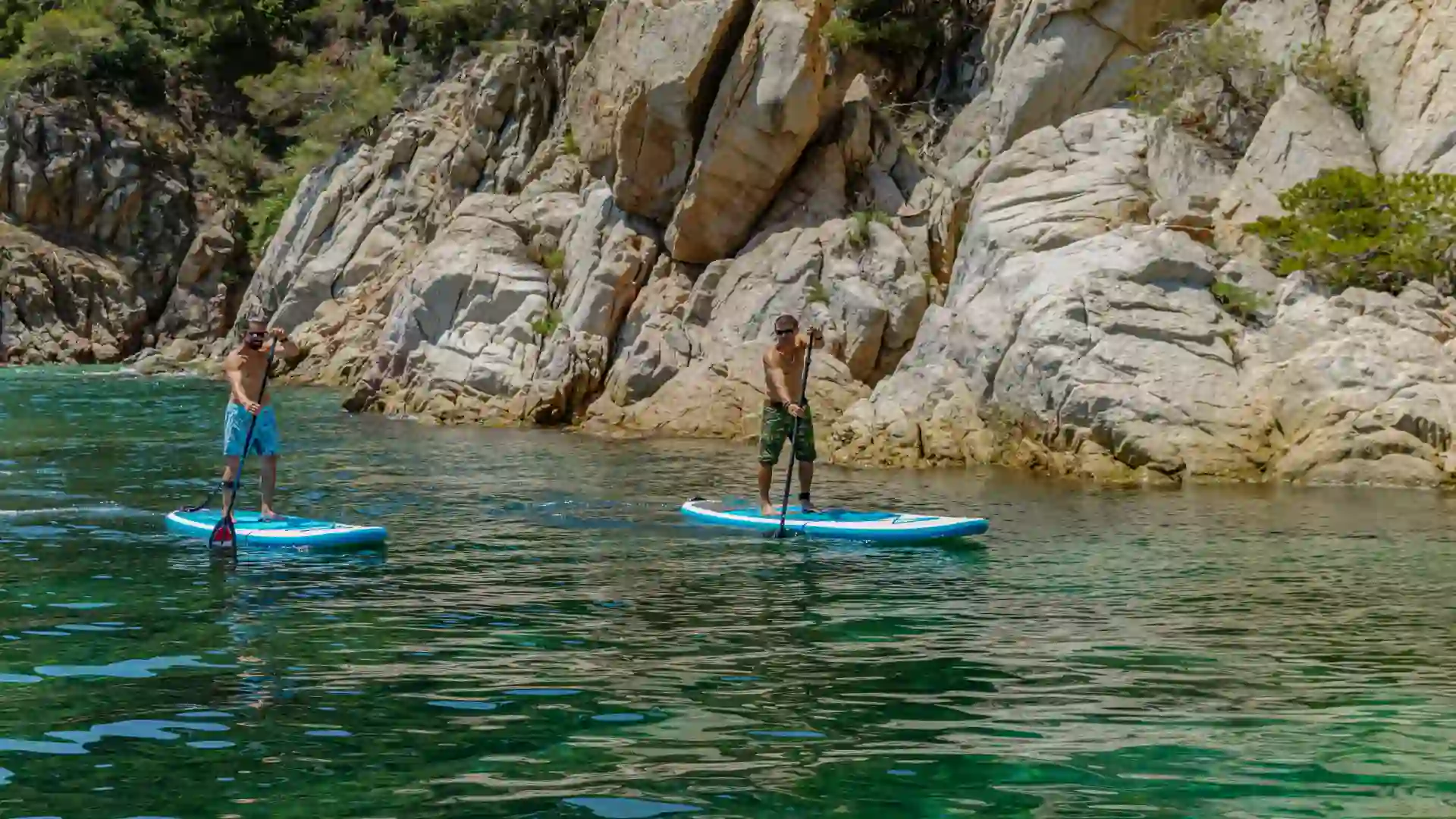
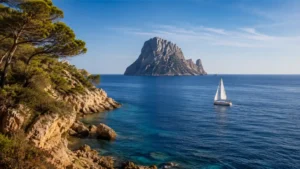
Discuss calm waters in western Formentera This forces us to make a distinction that should always be respected at sea: the image of calm is one thing, and the actual stability of a coastline is quite another. The western side of the island, with Saône Cove As its most recognizable landmark, it typically projects a distinctly Mediterranean serenity: dense turquoise water, reddish terrain, small inlets nestled among the rocks, and a clear horizon at dusk. This impression is no accident. The very configuration of the coastline, more indented and sheltered than other open stretches of the island, explains much of this feeling of refuge. Cala Saona, in fact, appears as a small cove between cliffs and as the only sandy beach tucked away in this southwestern part—precisely the kind of shape that alters the experience of the water so close to land.
The western coast of Formentera can't be easily understood through the generic notion of a "pretty beach." It's understood through geography. While other areas of the island open up more clearly to the horizon, here the coastline becomes more intimate: low in some sections, steep in others, with rock walls, small steps, and inlets that break the line of the waves and arrange the light differently. This makes the water, when the swell is calm, appear more still, more polished, as if the surface has slowed down. It's not just an aesthetic matter. The seabed also plays a role, as does the gentle slope of the beach within the cove and the way the waves are dampened when they find shelter.
That calm, however, shouldn't be taken as a permanent promise. The most common mistake when observing the western coast of Formentera from the shore is thinking that a beautiful sea equates to a still sea. The western coast often offers pristine scenes, yes, but the visual serenity can be shattered as soon as the wind changes or a swell begins to blow. swellThere are days when the surface is as smooth as a sheet, and others when the bay itself immediately reveals its vulnerability. Therefore, in nautical terms, this part of the island is much more appreciated when viewed objectively than when idealized. The charm of the west coast lies not in feigning stillness, but in offering moments of great marine beauty when the overall scene aligns. This is an important distinction for anyone who experiences Formentera from the deck, and not just from the sand.
The logic of the shelter on the west coast
The island's western coast possesses a rare quality in environments so exposed to the open blue: a sense of refuge without sacrificing visual breadth. Saône CoveThe bay is nestled between Punta Rasa and Caló d'en Trull, and this geometry is crucial. A cove doesn't need to be large to be comfortable; sometimes the opposite is true. When the opening is well-oriented and the topography is favorable, a smaller scale can soften the entry of short waves, regulate their rebound, and make swimming a more pleasant experience.
From the sea, this logic is even more apparent. The western coast of Formentera doesn't offer the infinite, horizontal transparency of the vast stretches of the north; it offers something else: seclusion. The gaze isn't drawn to a continuous shoreline, but rather to the island's contours, rocky slopes, boathouses, changes in color on the seabed, and a very clear transition between the light sand and the deeper blue of the water. This visual reading allows you to anticipate quite well where the water will be calmer and where it will begin to move with more energy. Inside a cove like this, the calm is often more tangible: you feel it when you enter the water, when you see a shadow float on the seabed, when you hear less surf and more the sea breathing.
It's also worth considering the scale of the place. Cala Saona hardly needs a grand scale to function as a small natural theater of the island's western coast. In spaces like this, every meter changes dramatically. The shoreline might be calm, while just beyond the harbor entrance, a different energy is already palpable. This difference in behavior over short distances is one of the reasons why this coast evokes such fascination among those who look beyond the landscape and focus on the sea. There are no grand displays; there are nuances.
When calm doesn't depend solely on the wind
One of the most valuable lessons in Formentera is that the calmness of the water never depends on a single factor. The wind certainly plays a role, but it's not the only one. In westerly conditions, the orientation of the cove's entrance, the persistence of previous swells, the refraction off the rocks, and the type of seabed also all contribute. This is why very deceptive situations can arise: relatively calm air, clear skies, and yet the water is less comfortable than expected due to lingering swells. Or vice versa: a day that looked unpromising from land can turn out to be an excellent swim inside a well-sheltered cove.
In Cala Saona, the difference between appearance and reality becomes especially visible. It's a cove capable of being serene, but not immune. This duality is, in fact, good news for those who know how to observe. It means that the western shore isn't a static backdrop, but a living, sensitive coastline, full of signs. The light changes, the texture changes, the way it breaks the outer line changes. And each of these variations tells a story.
This is where a rather unassuming but crucial concept comes into play: the time of the sea. On islands like Formentera, the sea's memory lasts longer than it sometimes seems. A coastline can dawn calm and still bear the imprint of what happened before, just as it can experience a disturbance mid-day that takes time to be perceived from land. The westerly wind, due to its scale and topography, allows us to clearly read this memory. Simply observe whether the water flows smoothly into the water or, on the contrary, arrives with a long, almost imperceptible breath, shifting the bathers into a less steady rhythm. It is not a dangerous sea by definition; it is a sea that should be observed with patience.
The difference between swimming and anchoring
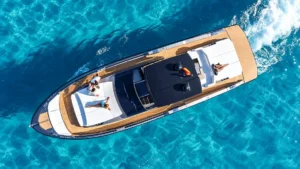
Some coastlines are best appreciated from the beach towel, while others reveal their true character from the bow. Formentera's west coast clearly belongs to the latter group. For swimming, the feeling of shelter might suffice. For the anchorage in FormenteraHowever, other questions come into play: how well the seabed grips, how much dragging the space allows, what actual protection the topography offers, and how discomfort might evolve if the sea turns or rises. At this point, it's important to separate romanticism from practical considerations.
The small bay of Cala Saona can be very pleasant under certain conditions and less comfortable when the sea comes in from other directions. This practical interpretation fits with what the landscape reveals: a sheltered cove, useful in specific situations, but not designed to withstand everything. Stating it this way doesn't diminish its beauty; it enhances it. Because the most elegant sea isn't the one that promises too much, but the one that clearly expresses what it's good for and what it's not.
From an experiential point of view, the difference between swimming and anchoring is noticeable. Swimmers seek a gentle surface, minimal visual undertow, and a clear entry into the water. Boaters also need mental space: predictability. In the western waters off Formentera, both often coincide, but not always. There are times when the water seems perfect for swimming, and yet, the time spent on board becomes less comfortable due to rolling, waves crossing the water, or other maritime traffic. Anyone who knows Formentera well knows that comfort isn't measured solely by the color of the water.
That nuance explains why the west coast is so appealing to those seeking beautiful seas and subtle interpretations. It's not a flashy coast. It's a coast of details. A place where color can dazzle and, at the same time, compel reflection. Perhaps that's why it remains so magnetic: because it doesn't fully reveal itself at first glance.
The West as a sensory landscape
There's something very particular about western Formentera that goes beyond sailing, and yet stems from it. The afternoon light flattens the landscape less and accentuates the textures more. The reddish cliffs of the area of Rasa Point They don't just frame the water; they give it a distinct visual temperature. The blue appears deeper, the sand paler, the rock warmer. This combination creates a calm that is often mistaken for silence, though it isn't exactly that. It's more of a reduction of maritime noise: less open waterfront, less feeling of exposure, more coastal intimacy.
This sensory dimension matters because it alters how water is perceived. A calm sea is not only seen; it is also interpreted through its surroundings. On an open coast, the vastness can exaggerate the movement. In a sheltered cove, the rocks can visually soften it. This is why the western coast of Formentera is often experienced as a more peaceful place, even when the sea is not completely still. The landscape helps to maintain the impression of tranquility.
This shouldn't be mistaken for an artificial calm. On the contrary. What makes this part of the island special is that the tranquility arises from a balanced relationship between coastal form, light, orientation, and scale. There's no grandiosity. Everything unfolds on a low scale: the line of a boathouse, a change in the water's color, a rock face that cuts through the wind, a cove's entrance that tames the waves. It's a beauty of precision.
Other shores of Formentera and why the west feels different
To truly understand the western part of the island, it helps to mentally compare it with other areas. The environment of Es PujolsFor example, it responds to a different logic: more human continuity, a different relationship with the shore, a different way of entering the sea. The west coast, on the other hand, retains a more geological, more contained interpretation, closer to the idea of a natural refuge. It's neither better nor worse; it simply speaks a different coastal language.
This difference is even reflected in the visitor's expectations. Those who think of the north or the more open areas of Formentera tend to imagine transparency, vastness, luminous depths, and a wide horizon. Those who think of the west imagine seclusion, rock formations, sunsets, relative shelter, and serene water nestled among the shapes that contain it. That's why the west leaves a different impression: less expansive, more intimate.
And perhaps therein lies its deepest editorial value. The western coast of Formentera teaches that sea calm isn't always measured by the absence of movement, but by proportion. When everything is in its place—a reasonable wind, orderly seas, favorable light, and the topography working in its favor—the sunset offers one of those scenes that seem simple, yet are full of quiet artistry. The sea makes little noise, but says a great deal.
Things to consider before taking tranquility for granted
There's a very Mediterranean custom that rarely fails: pausing for a moment before entering the water and looking around. On the western coast of Formentera, this gesture is doubly important. It's wise to look at the outer surface of the cove, not just the shore; notice whether the water forms long lines or small, short ripples; observe whether the boats are very stable or barely pitching; pay attention to the color of the seabed, because extreme transparency also reveals movement when light passes through an overly vivid surface.
It's also helpful to consider the size and occupancy of the space. Cala Saona is a relatively small and highly popular beach, so the perception of tranquility can be disrupted not only by the sea but also by the current level of activity and boating. In such settings, natural calm coexists with a more intense dynamic of use, and this changes the experience of the water even when conditions are otherwise favorable.
Finally, it's worth remembering something fundamental: in Formentera, the beauty of the water isn't a given, but it is an invitation to observe more closely. The westerly winds reward that attention. The more you understand their scale, their shelter, and their limits, the more beautiful they become. Because the true tranquility of the sea doesn't lie in believing it will never move, but in knowing why, when, and how it becomes still.
Doubts that arise when looking at the sunset from the sea
Does the water on the west side of Formentera always have calmer conditions?
Not always. It often offers a feeling of shelter in specific spots, especially in areas like Cala Saona, but the actual calm depends on the wind, the residual sea, and how the waves are coming in at any given time.
Why does Cala Saona convey such a strong sense of refuge?
Because it's a small cove nestled between cliffs, tucked into a landscape that alters the experience of the wind and waves near the shore. Its sheltered shape greatly changes the perception of the water.
Does calm water mean anchoring will be comfortable?
Not necessarily. Comfort while swimming and comfort while anchoring are not exactly the same thing. For the vessel, the seabed, orientation, sea conditions, and available space also matter.
What visual cues help determine if the calm is stable?
The surface texture outside the cove, the balance of the boats, the presence of long swell lines, and the way the water breaks at the entrance usually provide very clear clues.
Is the western part of Formentera similar to other beaches on the island?
It shares the transparency and color of water, but not the same spatial experience. Compared to more open or urban areas, the west feels more geological, more contained, and more intimate.
Where the sea seems to lower its voice
On the western coast of Formentera, tranquility is never entirely accidental: it arises from a coastline that embraces, a light that brings order, and a scale that compels closer observation. That's why places like Saône Cove They remain in memory with a special clarity, just as a certain image of the Mediterranean remains when contemplated from the deck or from the sand at a leisurely pace. Everything surrounding the coastline also fits into this unhurried reading of the shoreline. boat rental in Ibiza when the sea is considered not as something to be consumed quickly, but as a way to better understand the landscape, its silences, and the exact measure of its beauty.