Stand-up paddleboarding (SUP) has a very special relationship with Ibiza. Unlike other, faster-paced water sports, it demands silence, a keen understanding of the sea, and a certain sensitivity to recognize when a beach is truly calm. It's not enough for the water to look beautiful from the shore. For comfortable paddling, the bay's orientation, the prevailing wind, the exposure to the waves, the type of seabed, and the presence of nearby boat traffic all play a role.
Ibiza offers particularly pleasant conditions for this activity: clear waters, sheltered coves, open beaches with easy access, and inlets where the coastline allows for slow, gentle movement, almost at rock level. To speak of beaches for paddle surfing in Ibiza This doesn't mean creating a rigid list. The sea changes from one morning to the next. A perfect cove with a light breeze can become uncomfortable with crosswinds; an urban beach, seemingly less spectacular, can offer a clean paddle at dawn. The key is to look at the island with a nautical perspective, not just a photographic one.
What makes a beach suitable for stand-up paddleboarding (SUP) surfing
A good beach for stand-up paddleboarding needs easy access, minimal surf, enough space to get away from swimmers, and stable water levels for most of the day. In Ibiza, many coves nestled within inlets offer this kind of natural shelter, especially when the wind isn't blowing directly in front of you.
The first factor is orientation. West-facing beaches can be pleasant with calm seas, but more susceptible to rougher conditions when the west wind blows. East and southeast-facing areas usually offer serene mornings with gentle breezes, although it's always wise to keep an eye on how the day is developing. Stand-up paddleboarding is best enjoyed when the board isn't struggling against the water.
The second factor is the seabed. Gently sloping sandy beaches make getting out easier, allow you to get on your board without rushing, and reduce the feeling of exposure. Rocky seabeds, on the other hand, offer visual beauty but require more attention when entering and exiting the water. In Ibiza, the water's clarity makes it easy to read the seabed.
The third factor is coastal shelter. A deep cove, a sheltered bay, or a stretch protected by cliffs can reduce the effect of wind and small waves. In nautical terms, it is important to observe the fetchThat is, the free distance over which the wind can push the sea surface before reaching the shore. The shorter this distance, the more orderly the water surface tends to be.
Cala Llonga: spacious, sheltered and a comfortable exit
Cala Llonga It is one of the most obvious beaches when you think of paddle surfing in Ibiza with a practical point. It is located in a deep cove near Santa Eulària, with a wide expanse of sand and clear waters, which gives it a very accessible character for paddling without feeling confined.
Its main virtue is its balance. It's not a tiny cove where each board seems to take up too much space, nor a beach so open that the wind immediately takes over. The width of the bay allows you to move forward gradually, gain confidence, and explore the sides when the sea is calm.
From a nautical perspective, Cala Llonga works particularly well on calm days or when breezes don't blow directly into the bay. The rocky sides provide visual landmarks and some protection, while the sandy bottom allows for easy entry. It's a beach where paddling can be very clean if you start early, before the activity of boats and swimmers increases.
However, its calm appearance shouldn't be a deterrent. As with any secluded beach, if the wind blows in line with the cove, it can create a small surface current flowing inwards or outwards. For stand-up paddleboarding, this is more important than the distance traveled.
Talamanca: urban paddling with the soul of a bay
Talamanca has an advantage that is sometimes underestimated: its bay shape. Close to Ibiza Town, it offers a wide expanse of water, easy access, and an orientation that can be very pleasant on calm days.
The experience here isn't that of an isolated cove, but rather a Mediterranean paddle with an open horizon, clear waters, and subtle urban landmarks. For those seeking Ibiza beaches with calm watersTalamanca can have excellent moments, especially in the early hours, when the bay maintains an almost flat stillness.
The appeal of this beach lies in its rhythm. It allows paddling parallel to the shore, maintaining a safe distance from the beach, and working on technique without venturing into overly exposed areas. As it's a bay with nearby nautical activity, attention should be paid to the surroundings: buoys, channels, small boats, and wave changes caused by maritime traffic.
Talamanca teaches an important lesson: not all ideal beaches for stand-up paddleboarding have to be remote. Sometimes, the best paddle is the one that starts easily, stays steady, and allows you to read the sea without rushing.
Cala Vadella: natural shelter and contained water
Cala Vadella, in the southwest, is a secluded cove, flanked by hillsides and with an entrance to the sea that often invites leisurely paddling. Its enclosed shape creates the feeling of a natural swimming pool when conditions are right, something that many SUP schools and practitioners appreciate for the visual safety the surroundings offer.
The cove allows for slow paddling close to the sides, always paying attention to the bottom and the presence of other people in the water. On calm days, the board glides across a sheltered area, with the landscape of pines and rocks defining the perimeter.
To SUP in IbizaCala Vadella has a clear aesthetic virtue: it doesn't require paddling long distances. Simply paddle slowly, stop, observe the seabed, and change sides depending on the wind. In this type of cove, stand-up paddleboarding isn't measured in kilometers, but in balance.
Its tricky point arises when the cove becomes too busy or when the wind blows directly in. Being relatively enclosed, any internal movement is more noticeable. Therefore, rather than focusing on universal schedules, it's best to read the surface: if there are small, repeated ridges, the paddling will cease to be contemplative and will become more physical.
Cala Bassa: transparency, sand and attention to the wind
Cala Bassa is one of the most recognizable beaches on Ibiza's west coast, known for its clear water, sandy bottom, and pine forest. For stand-up paddleboarding (SUP), its beauty should be tempered with caution. Its western orientation can offer days of absolute calm, but it can also bring swells or winds that complicate the return trip if you paddle too far out. On a board, the outward journey always seems easier when the wind is favorable; the return trip reveals the true conditions of the day.
Cala Bassa works well for short paddles, parallel to the shore and without straying far from the relative shelter of the bay. The transparency of the seabed provides a very special sensation, especially in the sections where the sand blends with patches of Posidonia seagrass. This visual experience of the seabed is part of the charm of stand-up paddleboarding in Ibiza.
Here it is especially important to respect swimming areas, channels, and boat traffic. This is not a cove for disconnecting from the environment, but rather for mindfully immersing oneself in it. The beauty of Cala Bassa demands a nautical perspective, not just enthusiasm.
Portinatx: protected north and a route between small beaches
Portinatx, in the north of the island, offers a different setting. It's not a single beach, but a small coastal area with several sandy inlets, high rocks, and clear waters.
For stand-up paddleboarding (SUP), Portinatx can be especially appealing when the north is calm. Its small bays allow you to paddle short distances, change your bearings, and explore without having to undertake long journeys. The landscape is more rugged than in other areas, with rocks, sharp contours, and a wilder coastal feel.
The key is not to underestimate the north. Although some entrances are sheltered, exposure to wind and swell can change rapidly. In calm conditions, Portinatx offers a beautiful paddle; with an open wind, the board can become unstable and the return more challenging.
In editorial terms, Portinatx represents a more contemplative form of paddle surfing: less wide-open beach, more exploring hidden corners. The board becomes almost a floating lookout point from which to observe the coastline at low speed.
Playa d'en Bossa: ample space and early morning paddling
Playa d'en Bossa is long, open, and very well-known, but it can also offer suitable spots for stand-up paddleboarding (SUP) if you understand its characteristics. The beach's width allows for easy entry and keeping parallel to the shore, especially on calm mornings.
It's not a sheltered cove in the strictest sense. Its exposure makes it highly dependent on the wind and sea conditions. When the surface is smooth, it offers an easy, bright, and expansive paddle; when a cross breeze or swell picks up, it quickly loses that pleasant character.
Its appeal lies in its continuity. Unlike a small cove, here the feeling is one of a horizon, a long line, a constant rhythm. It can be a useful beach for working on technique, balance, or paddle stroke rate, provided the initial assessment is correct.
The presence of other water sports requires orderly paddling. On a wide beach, the space doesn't eliminate the need for attention. Stand-up paddleboarding, even in calm waters, remains a light and efficient form of watercraft.
Cala Tarida: clear water and skillful paddling
Cala Tarida combines sand, clear waters, and an open landscape facing west. It's a very scenic beach, with attractive swimming areas and changes in depth that are easily appreciated from a surfboard. This transparency allows you to enjoy the seabed, but also requires caution in windy conditions.
As with other western beaches, Cala Tarida can be wonderful when calm but less advisable when the wind picks up. Its orientation, size, and the possible presence of small surface currents make it better suited to short, controlled paddles than to paddling out without a plan.
The appeal of Cala Tarida for stand-up paddleboarding lies in its light. The board glides across distinct shades of blue, with light sand and rocky areas that add texture to the landscape. In calm conditions, it's one of those beaches where paddling slowly makes more sense than covering distance.
Within quiet coves IbizaIt's important not to confuse beauty with permanent shelter. A cove might appear tranquil from the sand, yet reveal gusty winds just a few meters out. Stand-up paddleboarding teaches precisely that: the difference between looking at the sea and reading it.
Cala Gracioneta and Cala Gració: small scale, intimate paddle
Cala Gració and Cala Gracioneta, near Sant Antoni, offer a more intimate experience. These aren't beaches for long walks, but rather for a brief, sheltered encounter, where you're mindful of the surroundings. When the sea is calm, they offer a tranquil expanse and a pleasant environment for paddling close to shore.
Its size, however, necessitates careful coexistence with swimmers and other activities. In small coves, a board is quite noticeable. Good practice involves setting out discreetly, staying away from crowded areas, and avoiding sudden maneuvers near the shore.
The appeal of these coves lies in the intimacy of the landscape. Close-knit rocks, clear water, short distances between landmarks, and a feeling of refuge. For those who see paddle surfing as contemplation rather than a journey, they can be quite enchanting.
Limitations are also part of the criteria. Not all beaches are suitable for long paddles; some are for floating, observing, and returning. In Ibiza, this measure often makes the difference between an elegant experience and an intrusive one.
Real questions before rowing in Ibiza
What wind conditions should be avoided for paddle surfing in Ibiza?
Rather than memorizing a specific wind, it's more important to observe whether it blows directly onto the beach or from the land out to sea. An offshore wind might feel comfortable at first, but it gradually pulls the board away from the shore. For stand-up paddleboarding, this scenario demands extreme caution.
Is it better to row in the morning or in the afternoon?
Generally, the early hours tend to offer a smoother surface and less traffic in the water. In the afternoon, the thermal breeze can increase and create small, short waves that make it difficult to balance. It's not a hard and fast rule, but it is a common pattern on the Mediterranean coast.
What type of beach is most helpful for beginners?
Sandy beaches with a gentle slope and sheltered bays are more inviting. They allow you to enter the water at your leisure, fall in safely, and easily return to shore. Lateral protection and the absence of surf are more important than the beach's reputation.
Is it possible to paddle near rocks and cliffs?
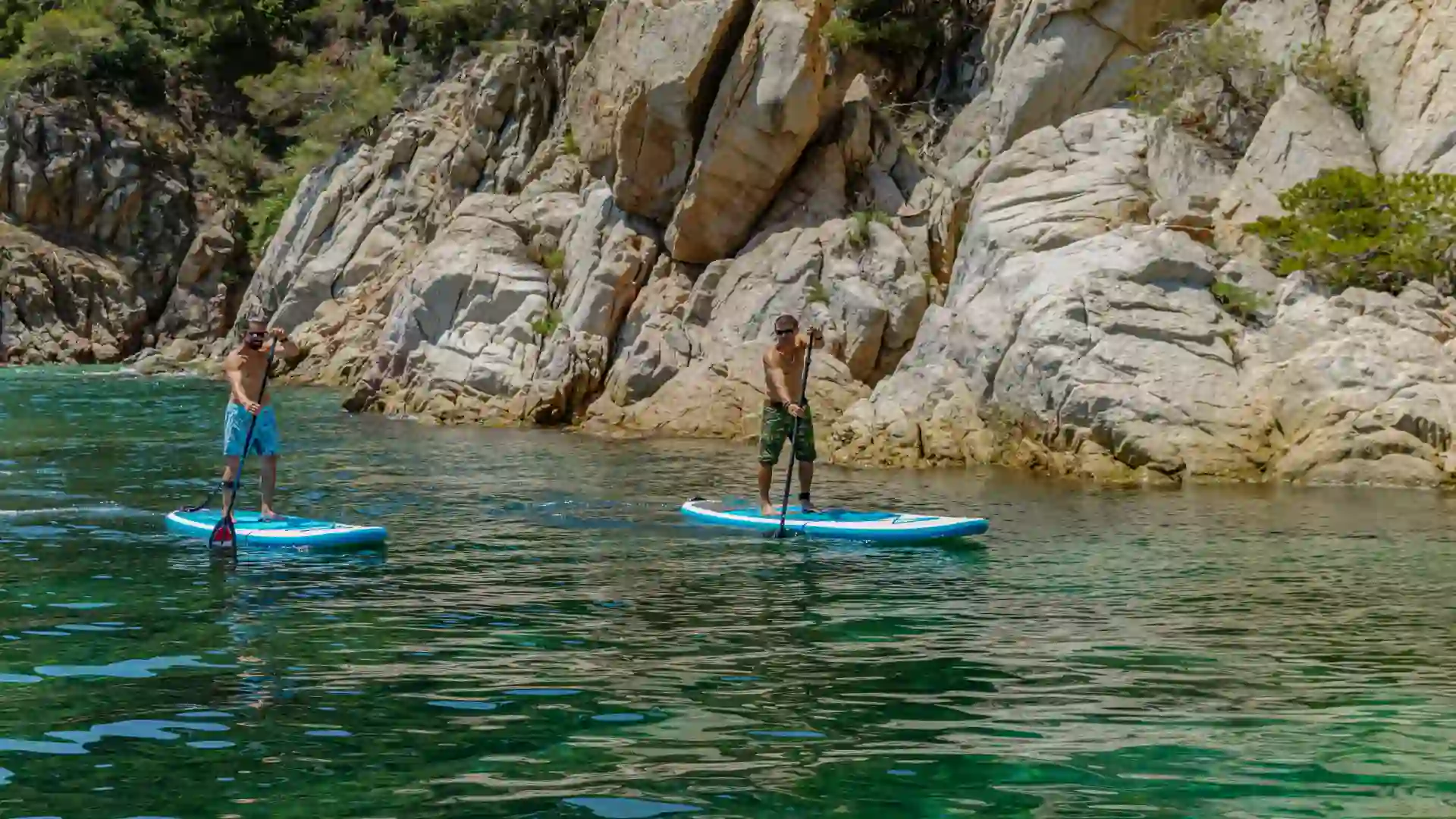
Yes, when the sea is calm and there's enough distance, but it's not advisable to get too close. The waves crashing against the rocks can destabilize the board, even in seemingly calm seas. Also, some areas have uneven seabeds or narrow passages.
What sign indicates that a cove is not suitable for SUP?
A surface with repeated small ridges, a constant crosswind, or difficulty keeping the board oriented usually indicates that the paddling will be more demanding. If the outward journey requires little effort but the return seems uncertain, it's best to shorten the trip.
Calm can also be chosen from the sea.
Ibiza is not the same from a board as it is from the sand. Paddle surfing forces you to slow down, to notice the driftto distinguish a truly protected bay from a mere blue postcard. In that dialogue between beach, wind, and seabed, a serene way of looking at the island emerges, the same way that sustains the nautical culture of Luxury Dreams Ibiza and also gives editorial meaning to the boat rental in Ibiza when viewed as a way of reading the coast with respect, distance and Mediterranean sensitivity.